Chiropractor in Kenosha, WI
Chiropractic Care in Kenosha, WI
Get out of pain and back to living your normal life
Hands-on chiropractic care designed to help you feel better, faster.
Back pain • Neck pain • Injury recovery • Chronic discomfort
Simple, straightforward care
Questions? Talk to a real person
Still dealing with pain? Let’s fix that.
HOW WE HELP
Back pain Relief
Targeted care to reduce pain and improve mobility.
Neck Pain Relief
Relieve tension, stiffness, and restore movement.
Injury Recovery
Recover faster with personalized treatment.
Chronic Pain Care
Reduce long-term discomfort and improve daily life.
WHY CHOOSE US
Simple care. Real results. No guesswork.
✔ Personalized treatment plans
No cookie-cutter care. Everything is tailored to your condition and goals.
✔ Hands-on approach
Focused chiropractic adjustments with supportive therapies when needed.
✔ Clear communication
You’ll always understand your treatment and what to expect.
✔ Local, trusted care
Serving patients across Kenosha with consistent results.

MEET DR. MURPHY
Helping patients in Kenosha find real relief from pain
Dr. Murphy has been helping patients in Kenosha find relief from pain through personalized chiropractic care. His approach focuses on listening first, identifying the root of the problem, and creating a clear plan to help you feel better.
Patients appreciate his straightforward style, attention to detail, and commitment to getting real results without unnecessary complexity.
What to expect on your first visit
Simple, straightforward care focused on helping you feel better.
01
Consultation
We listen first
We take the time to understand your pain, symptoms, and what’s been bothering you.
02
Evaluation
Find the root cause
A focused evaluation helps identify what’s actually causing your discomfort.
03
Treatment Plan
Clear next steps
You’ll get a straightforward plan designed to help you feel better — no guesswork.
No pressure. No long-term commitments. Appointments available this week.
Herniated Disc vs. Bulging Disc: What's the Difference and Can Chiropractic Help?
Herniated Disc vs. Bulging Disc: Chiropractic Treatment Options in Kenosha
If you’ve had an MRI and been told you have a herniated or bulging disc, you may have walked out of the imaging center with more questions than answers. What exactly does that mean? Is one worse than the other? Do you need surgery? Can chiropractic care actually help?
Dr. John Murphy at Murphy Chiropractic in Kenosha, WI has been treating disc conditions for over 30 years. Here’s a clear, practical explanation of the difference — and what conservative chiropractic care can do for both.
Understanding the Spinal Disc
Before comparing herniated and bulging discs, it helps to understand what a normal spinal disc is.
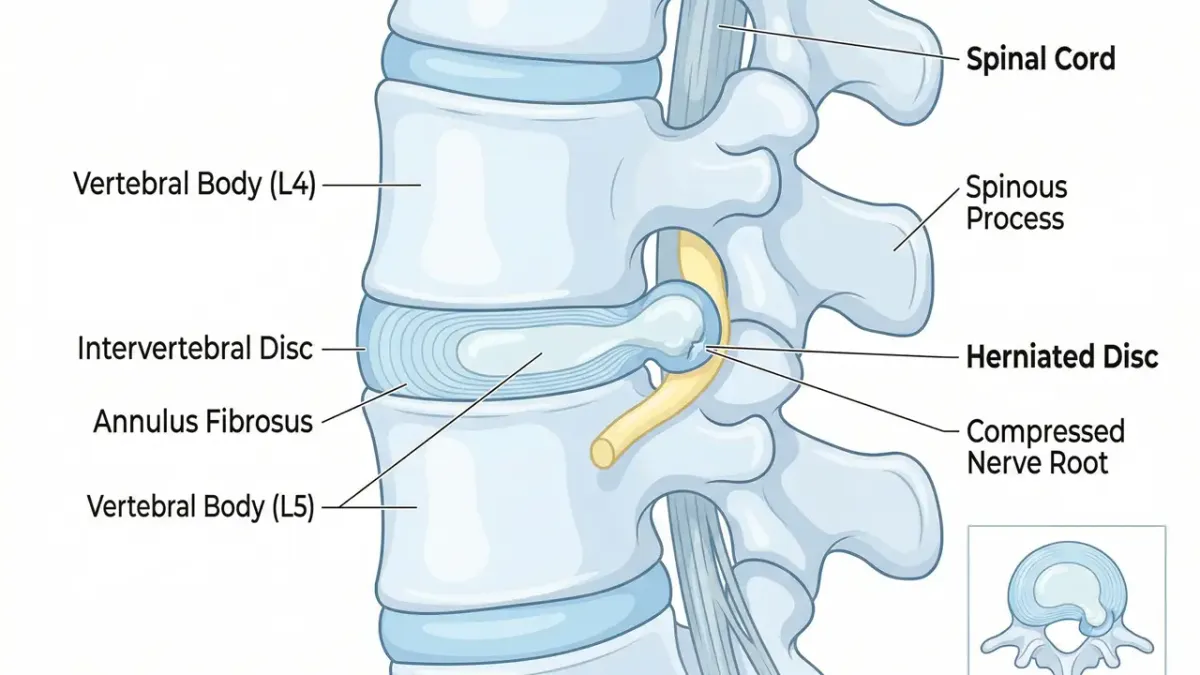
Intervertebral discs sit between each vertebra in your spine. Each disc has two parts:
- Annulus fibrosus — The tough, fibrous outer ring. Think of it like a radial tire — multiple layers of fibrous tissue arranged in crisscrossing bands for strength.
- Nucleus pulposus — The soft, gel-like center. It’s under pressure (like a water balloon inside the tire) and acts as the disc’s primary shock absorber.
The disc has no direct blood supply, so it depends on the pumping action of spinal movement to receive nutrients and expel waste. This is one reason that movement is so important for disc health.
What Is a Bulging Disc?
A bulging disc occurs when the nucleus pulposus shifts toward one side of the disc, causing the outer annulus to deform and protrude outward — but not break through. Think of it like squeezing a hamburger on one side so the filling bulges out toward the other side, but the bun stays intact.
Bulging discs are extremely common. Studies have found that a significant percentage of people with bulging discs have no symptoms at all — it’s often an incidental finding on MRI. However, if a bulge presses against a nerve root or the spinal cord, it can cause significant pain.
Key characteristics of a bulging disc:
- The annulus fibrosus is intact (no tear)
- The bulge typically extends over a broader area (more than 25% of the disc circumference)
- Often associated with degenerative disc disease
- May or may not cause symptoms
What Is a Herniated Disc?
A herniated disc occurs when the nucleus pulposus actually breaks through a tear or crack in the annulus fibrosus. This is more severe than a bulge — the inner material escapes the containment of the outer ring.
The herniated (also called “ruptured” or “slipped”) disc material can press directly on nerve roots exiting the spine, causing sharp pain, numbness, tingling, and weakness that often radiates into the arms or legs.
Key characteristics of a herniated disc:
- The annulus fibrosus has a tear or rupture
- Nuclear material has escaped through the outer ring
- More localized than a bulge
- More likely to cause symptoms, including radiculopathy (nerve pain radiating into limbs)
- More likely to cause significant inflammation (the nucleus material is chemically irritating to nerve tissue)
So Which Is Worse?
Generally, a herniated disc is considered more severe because the annulus has been compromised and the nucleus material — which is chemically inflammatory — is in contact with sensitive nerve tissue. However, symptoms don’t always follow severity. A minor herniation in a sensitive location can cause more pain than a significant bulge in a less critical area.
What matters most from a treatment standpoint isn’t just the imaging findings — it’s the whole clinical picture: what symptoms you have, how long you’ve had them, how they affect your function, and what conservative care options are available.
Can Chiropractic Care Help?
Yes — and for most patients with disc conditions, conservative care including chiropractic should be the first-line treatment, not surgery. Research consistently shows that the majority of patients with herniated or bulging discs improve significantly with conservative care, and that outcomes from surgery are often no better than outcomes from conservative treatment in many cases.
At Murphy Chiropractic in Kenosha, Dr. Murphy uses several proven approaches:
PROTEC Floating Manipulative Therapy
This is our primary tool for disc conditions. PROTEC creates negative intradiscal pressure in the seated position — essentially “unloading” the disc. This negative pressure:
- Encourages retraction of herniated disc material away from the nerve
- Allows the disc to rehydrate with nutrient-rich fluid
- Reduces pressure on compressed nerve roots
- Promotes healing of annular tears over time
Chiropractic Spinal Adjustments
Carefully applied spinal adjustments restore proper motion to the vertebral segments surrounding a herniated disc. When vertebrae become restricted and misaligned, they can worsen disc deformation and nerve compression. Adjustments reduce this mechanical load and create an environment more conducive to healing.
Dr. Murphy uses gentle, specific adjustment techniques for disc patients — not the high-velocity maneuvers you might imagine. The adjustment is tailored to your diagnosis, symptoms, and tolerance.
MedX Low-Level Laser Therapy
The nucleus pulposus material that escapes in a herniation is chemically inflammatory to surrounding nerve tissue. LLLT reduces this inflammation at the cellular level, which can significantly reduce the intensity of nerve pain.
Dry Hydrotherapy
Relaxing the muscles surrounding the affected disc segments before treatment allows more effective decompression and adjustment. It also reduces the protective muscle guarding that often accompanies disc injuries.
What If I’ve Already Had an MRI?
Bring it. Dr. Murphy will review your MRI findings alongside your clinical examination to develop a treatment plan that accounts for exactly what’s happening structurally. He’ll also explain what the report means in plain English — because “moderate left paracentral L4-5 disc herniation with contact of the descending L5 nerve root” can sound terrifying when it doesn’t have to.
When Is Surgery Actually Necessary?
There are situations where surgery becomes necessary for disc conditions — particularly when:
- There’s significant neurological deficit (foot drop, loss of bowel or bladder control)
- Conservative care has failed after an adequate trial
- There is severe, progressive neurological deterioration
For most patients, however, these criteria aren’t met, and surgery can be avoided with the right conservative treatment approach. Dr. Murphy will always be honest with you about when referral to a spine surgeon is the appropriate next step.
Get Your Disc Properly Evaluated in Kenosha
If you’ve been told you have a herniated or bulging disc — or if you’re experiencing the symptoms of one — don’t wait to get it properly evaluated. Early, appropriate treatment leads to faster recovery and better long-term outcomes.
Schedule your disc consultation at Murphy Chiropractic →
Murphy Chiropractic, S.C. | 3535 30th Ave, Suite 201, Kenosha, WI 53144 | (262) 697-7463

Appointments available this week!
Schedule your visit today!
(262) 697-7463
Contact Us
Email: [email protected]
Address:
3535 30th Ave, Suite 201,
Kenosha, WI 53144
Office Hours:
Mon-Wed: 8:00am – 5:00pm
Thursday: By Appointment Only
Friday: 8:00am – 5:00pm
Sat-Sun: By Appointment Only
Phone Number:
262-697-7463


Murphy Chiropractic, S.C.
Dr. John C. Murphy, D.C.
Licensed Chiropractor
Wisconsin License #3307-012
NPI 1891793394